How Mem0 Gives LLMs a Memory
If you use ChatGPT regularly, it remembers your name, your job, your preferences. Claude does this too. It feels like the model knows you — like there's some persistent thread connecting your conversations.
But that thread doesn't live inside the model. It lives in the application wrapped around it.
Here's what's actually happening under the hood: the application — ChatGPT, Claude.ai, whatever you're using — is storing facts about you in a separate system and quietly injecting them into the prompt before each request. The LLM itself is completely stateless. Every single API call to GPT-4, Claude, or Llama starts with a blank slate. The model has zero recollection of what you told it five minutes ago. The "memory" you experience is an illusion maintained by the application layer.
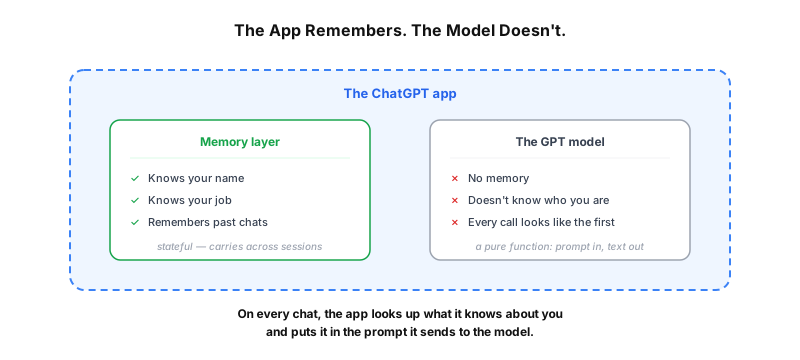 the app remembers
This illusion works fine when OpenAI or Anthropic builds it for you. But the moment you're building your own AI application — a support bot, a health coach, a coding assistant — you have to build that memory layer yourself. And the solutions most teams reach for are either wasteful, fragile, or both.
Mem0 is an open-source memory layer that sits between your application and your LLM, giving your agent the ability to remember. Not by stuffing the context window. Not by bolting on a RAG pipeline (more on what that is in a moment). By extracting, consolidating, and retrieving only the facts that matter.
Let me break down why this problem is harder than it looks, and how Mem0's architecture actually solves it.
The Three Walls of Context Stuffing
So ChatGPT and Claude handle memory for their own products. What's the big deal?
The big deal is that the naive version of their approach — replaying the conversation history into the context window on every call — runs into three hard walls the moment you try to build it yourself:
- Cost scales linearly. Every token in the context window costs money. Replaying a 50K-token conversation history on every API call is burning cash for information the model mostly doesn't need.
- Latency scales with context size. More tokens in = slower time to first token. For real-time applications (voice agents, chat), this is a dealbreaker.
- Models lose signal in noise. The "lost in the middle" problem is well-documented — a 2023 Stanford paper by Liu et al. showed that LLMs pay disproportionate attention to the beginning and end of their context, and important facts buried in the middle get ignored. A 100K context window full of raw chat history is a haystack where the model regularly misses needles.
So raw context stuffing fails on cost, latency, and accuracy simultaneously. You need something smarter.
The Obvious Next Step: RAG. And Why It's Not Enough.
The first thing most engineers reach for is RAG — Retrieval Augmented Generation. Chunk your conversation history, embed it, store it in a vector database, and retrieve relevant chunks at query time.
RAG is a solid pattern for document retrieval. But it has real limitations as a memory system:
Chunks are dumb boundaries. When you split a conversation into 512-token chunks, you're cutting across semantic boundaries. A user's dietary preference might be split across two chunks, and your retrieval might only grab one.
No deduplication or conflict resolution. If a user says "I'm vegetarian" in session 1 and "I started eating fish last month" in session 12, RAG will happily retrieve both chunks. Your model gets contradictory information and has to figure it out on its own. Sometimes it does. Often it doesn't.
No temporal awareness. RAG treats all chunks as equally valid. It has no concept of "this fact was superseded by a newer fact." The vector similarity score doesn't encode time.
Retrieval quality degrades with scale. As you accumulate thousands of chunks per user, the recall precision of top-k vector search drops. You start retrieving tangentially related chunks that dilute the useful context.
Here's the thing: RAG was never designed to be a memory system. It was designed to let an LLM answer questions against a static knowledge base — product docs, legal contracts, research papers. Things that don't change, don't contradict themselves, and don't need to be updated mid-conversation. For that job, RAG is excellent.
But memory is a fundamentally different problem. A knowledge base is read-only. Memory is read-write. A knowledge base doesn't care if document A contradicts document B — both can be true of different products, different jurisdictions, different time periods. Memory has to pick. When your user said "I'm vegetarian" in January and "I eat fish now" in March, there's only one correct current answer, and your system has to know which one it is.
So RAG asks: "What chunks in my corpus are relevant to this query?" Memory asks: "What is true about this user, right now, given everything they've ever told me?"
Those are different questions. The first is a retrieval problem. The second is a state management problem — and state management means extraction (pulling facts out of messy conversation), consolidation (merging new info with old), conflict resolution (deciding what supersedes what), temporal awareness (knowing when each fact became true), and selective recall (surfacing only what matters for the current query).
That's the gap between RAG and memory. And that's exactly the gap Mem0 is built to fill.
Mem0's Architecture: A Two-Phase Memory Pipeline
Mem0's core insight is that memory management should be a pipeline, not a store. Raw conversations go in. Distilled, deduplicated, temporally-aware facts come out. The pipeline has two phases: Extraction and Update.
Phase 1: Extraction
When a new message pair arrives (user message + assistant response), Mem0 doesn't just embed and store it. It runs an extraction step.
The extractor takes three inputs:
- The latest exchange — the most recent user-assistant message pair.
- A rolling summary — a condensed representation of the entire conversation history up to this point.
- Recent messages — the last N messages (typically ~10) for local context.
These three signals get fed to an LLM with a structured extraction prompt. The LLM's job is to identify salient facts — the pieces of information worth remembering. Not the small talk. Not the filler. The facts that would matter in a future interaction.
The output is a set of candidate memory entries. Natural language statements like:
- "User is vegetarian and avoids dairy"
- "User's target is 130g protein daily"
- "User prefers window seats on long flights"
The rolling summary is generated asynchronously by a separate background process. This is a key design choice. The summary refresh doesn't block the real-time conversation flow. It runs periodically, keeping the summary reasonably current without adding latency to the critical path.
Phase 2: Update
This is where Mem0 diverges from every naive memory implementation I've seen. Extracted facts don't just get appended to a store. Each candidate fact goes through a conflict resolution step.
For each extracted fact, Mem0:
- Retrieves the top-k semantically similar existing memories using vector embeddings.
- Presents the candidate fact alongside the retrieved memories to an LLM via a function-calling (tool call) interface.
- The LLM decides one of four operations:
- ADD — This is genuinely new information. Create a new memory entry.
- UPDATE — This enriches or modifies an existing memory. Merge it.
- DELETE — This contradicts an existing memory. Remove the old one.
- NOOP — This is redundant. The memory store already has this. Do nothing.
This is the critical difference. The LLM acts as a judge for memory operations. It's not just pattern matching on embeddings — it's reasoning about whether new information conflicts with, extends, or duplicates existing knowledge.
Every memory entry gets timestamped and versioned. When a DELETE happens, the old memory isn't physically destroyed — it's marked as superseded. This gives you an audit trail and enables temporal reasoning ("What did the user prefer before they changed their mind?").
The Storage Layer
So what actually stores these memories on disk?
Under the hood, Mem0 uses two storage backends, each doing a job the other can't.
Vector Store — This is the heart of it. Every extracted memory is converted into an embedding (a high-dimensional numerical representation of its meaning) and stored in a vector database. Mem0 supports the usual suspects — Qdrant, Pinecone, Chroma, Weaviate — you pick based on your stack. The vector store powers two things: during the Update phase, it finds semantically similar existing memories so the LLM judge can decide ADD / UPDATE / DELETE / NOOP. And at query time, when your agent asks "what does this user prefer?", the vector store finds the most semantically relevant memories to inject into the prompt.
Key-Value Store — For the boring but important stuff: user IDs, session metadata, agent configuration, timestamps, version numbers. Things that need exact lookups, not semantic search. You don't want to pay the embedding cost every time you need to check "which user is this?".
That's it. A vector store for meaning-based retrieval, a key-value store for exact lookups. Simple, fast, production-ready.
A note on graph memory: Mem0 ships an enhanced variant called Mem0ᵍ that adds a third store — a knowledge graph — on top of this. It captures entity-relationship structure (e.g.,
Alice → works_at → Google) which helps with multi-hop queries like "who manages the team at Alice's company?". It's genuinely useful for certain workloads, but it adds infrastructure complexity (you need Neo4j or similar) and is an enhancement, not a requirement. Base Mem0 — vector + key-value — is what 90% of use cases actually need.
The Numbers
Mem0 published results on the LOCOMO benchmark — a standardized test for long-term conversational memory. Compared to naive full-context replay, Mem0 delivers 91% lower p95 latency and 90%+ token cost savings, while scoring 26% higher on accuracy than OpenAI's own memory implementation. Biggest gains show up in temporal and multi-hop questions — exactly the queries that flat retrieval and context stuffing fail.
What This Looks Like in Code
The API is deliberately minimal. Here's the core loop:
pythonfrom mem0 import Memory
from openai import OpenAI

memory = Memory()
openai_client = OpenAI()

def chat(message: str, user_id: str) -> str:
    # Retrieve relevant memories
    memories = memory.search(query=message, user_id=user_id, limit=3)
    memories_str = "\n".join(f"- {m['memory']}" for m in memories["results"])

    # Build prompt with memory context
    system = f"You are a helpful assistant.\nUser memories:\n{memories_str}"
    response = openai_client.chat.completions.create(
        model="gpt-4",
        messages=[
            {"role": "system", "content": system},
            {"role": "user", "content": message}
        ]
    )
    reply = response.choices[0].message.content

    # Store new memories from this exchange
    memory.add(
        [{"role": "user", "content": message},
         {"role": "assistant", "content": reply}],
        user_id=user_id
    )
    return reply
Three operations: search, add, and the pipeline handles the rest. The extraction, conflict resolution, deduplication — all implicit. You don't manage the memory lifecycle manually.
Mem0 works with OpenAI, LangGraph, CrewAI, and ships SDKs for both Python and JavaScript. It defaults to gpt-4.1-nano for the internal LLM calls (extraction, conflict resolution), but you can swap in any supported model.
Where This Falls Short
Mem0 is honest about its design choices, and there are trade-offs worth understanding:
The LLM is the decision-maker. All conflict resolution, fact extraction, and update decisions are delegated to the LLM. There's no rule-based fallback or product-level orchestration. If the LLM makes a bad judgment call — decides to DELETE a memory it shouldn't have, or NOOPs when it should UPDATE — there's no guardrail. This is elegant in its simplicity, but it's a black box. You're trusting the LLM's reasoning on every memory operation.
Flat vector limitations. The base Mem0 (without graph) stores memories as independent facts. It doesn't capture relationships between them. For complex multi-hop queries, the graph variant is significantly better, but graph memory adds infrastructure complexity (you need Neo4j or similar) and is only available on the paid platform tier for the managed service.
No learning pipeline. Mem0 remembers facts. It doesn't learn patterns, build capabilities, or generalize across users. It's a memory store, not a learning system. If you need your agent to get smarter over time (not just more informed), Mem0 alone won't do that.
The Takeaway
The memory problem in AI isn't about bigger context windows. It's about building systems that know what to remember, when to update, and when to forget. That's a pipeline problem, not a storage problem.
Mem0's contribution is making this pipeline practical: a two-phase extract-then-update architecture, hybrid storage that combines semantic search with structured relationships, and an API simple enough that you're adding a few lines of code, not building infrastructure.
If you're building anything where users interact with your AI more than once, and you're currently solving memory by stuffing context windows or bolting on RAG, it's worth understanding what a purpose-built memory layer looks like. Mem0 is the most mature open-source option in this space right now.
The paper is worth reading if you want the full benchmark details. The repo is Apache 2.0. Go look at the code.